The methodology
We have not invented our own strategy framework. We have adopted Roger Martin's Playing to Win without modification.
We regard Playing to Win as the optimal business strategy framework, and uniquely implementable for recursive improvement in software.
Wizdim's purpose and values layers are additive. They reflect our view of their relationship to strategy and their importance as binding elements of organisational Intent.
Wizdim has no affiliation with, and no endorsement from, Roger Martin. We are simply giving credit where it is due, and recommend that users explore the links provided below.
Playing to Win is the work of Roger Martin and A.G. Lafley. All rights in the underlying books, articles, and newsletter remain with their authors and publishers; if you represent them and would like to discuss how we reference this work, we would welcome the conversation.
Roger Martin
Former Dean of the Rotman School of Management at the University of Toronto, named the world's number one management thinker by Thinkers50 in 2017, an advisor to the CEOs of global companies, and the author of decades of published strategy work. He continues to teach the method at scale.
What strategy is
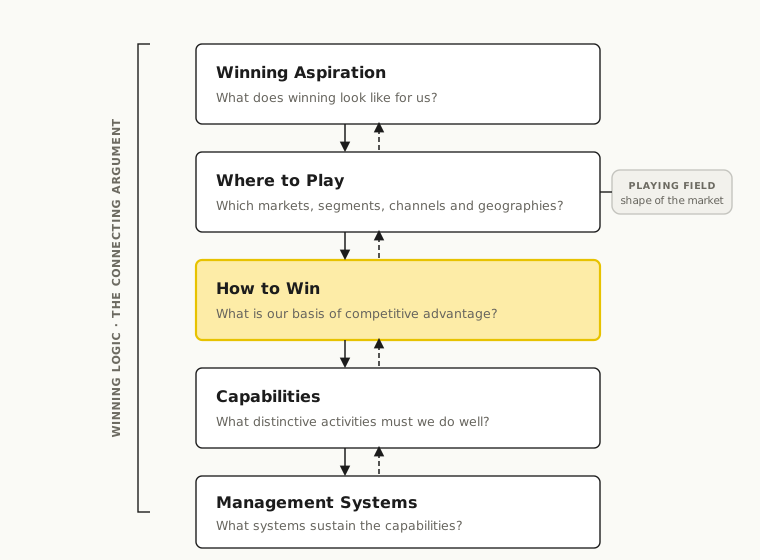
Martin's working definition: strategy is an integrated set of choices that compels a desired customer action. Not an aspirational document, and not a plan.
Winning Aspiration
What winning looks like for us.
Where to Play
Playing fields: which markets, segments, channels, and geographies.
How to Win
Our winning logic. Our competitive advantage.
Capabilities
The distinctive capabilities we require.
Management Systems
The management systems required to sustain our capabilities.
A plan is not a strategy. A plan is a list of activities; a strategy is a set of choices about where to play and how to win, made to hold together.
Because those choices concern an uncertain future, a strategy is a theory, not a certainty. As Martin puts it, you “can’t predict the future and can never be certain in advance that your chosen strategy is ‘right.’” The best a strategy can do is “shorten the odds of success. It can’t guarantee success.”
Playing to Win
Co-authored with A.G. Lafley, P&G's CEO during its most successful strategic era, and published by Harvard Business Review Press, Playing to Win is the standard text on business strategy. It condenses Martin's strategy practice into a single integrated cascade.
What Would Have To Be True
Martin calls this the most valuable question in strategy. Most strategy debates ask "is this option correct?", which triggers confirmation bias and ends in an argument. His question flips the frame: "what would have to be true for this to be the best option we could choose?".
That produces a list of testable conditions across three perspectives: customers and how they respond, the company's own capabilities and systems, and how competitors react. The barrier condition is the one you most doubt: the assumption that, if it fails, the strategy fails.
Wizdim captures these conditions and re-tests them on a cadence. When a condition starts to fail, the strategy is revisited, even if the rest of the business is humming.
The Responsibility Ladder
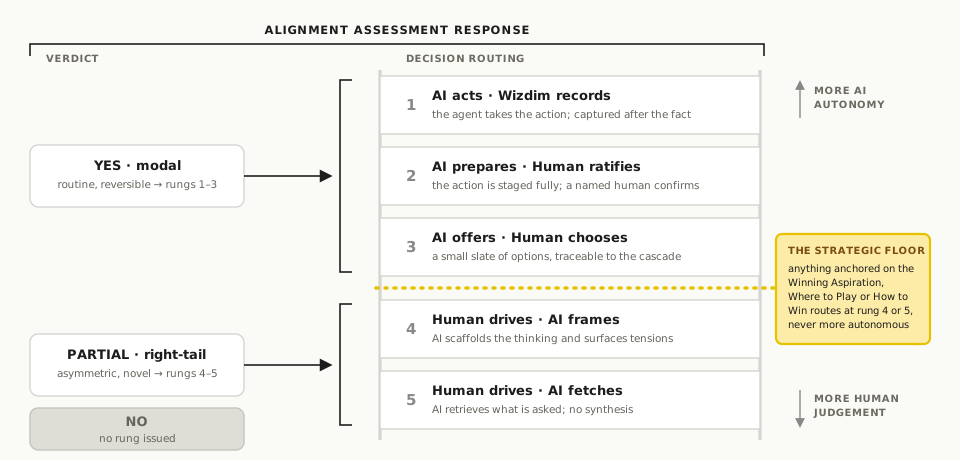
Martin's Responsibility Ladder, first set out in 2002 and restated in 2026 for the AI era, treats responsibility as a ladder of autonomy between human and AI, not a binary delegation.
Wizdim routes every assessed decision to a recommended rung. Strategically consequential decisions always stay human-led; they are never delegated to an averaging engine.
Go to the source
Optimal use of Wizdim requires deep familiarity with Martin's Playing to Win. Follow these links to the source materials.
Roger Martin
rogerlmartin.com
Essays, the Playing to Win practitioner's toolkit, and current writing.
Visit →The book
Playing to Win at HBR Press
Playing to Win: How Strategy Really Works, the expanded edition with bonus HBR articles.
Buy →Substack
rogerlmartin.substack.com
Roger Martin's newsletter, with regular essays on strategy and management.
Read →Watch: a plan is not a strategy
Roger Martin for HBR Quick Study, 2022, about ten minutes. Companion article: A Plan Is Not a Strategy.